For higher education leaders navigating demographic shifts, modern enrollment cliffs, and intensifying pressure around student persistence, "scaling student support" often sounds like an oxymoron. Traditionally, deep student connection lives within boutique, highly manual programs—models that inevitably fracture under the weight of an entire incoming class.
At the University of Wisconsin-Stout, a public polytechnic university, this friction is met with an ambitious strategic framework. Driven by a chancellor-led mandate to overhaul the student experience, UW-Stout set out to transform their peer mentorship initiative, MentorLink, from a small-scale pilot into an institution-wide engine for student persistence.

During a recent Mentor Collective webinar, Igniting Growth: How to Scale Your Mentorship Initiative, Jennifer Kious (Director of Marketing at Mentor Collective) joined Dr. Kelly Wenig, Director of the Blue Devil Achievement Center at UW-Stout where Wenig shared how his division scaled their mentor network by matching the entire incoming class in a remarkably compressed timeframe—all without blowing out staff headcount or compromising the human touch.
1. The Strategic Shift: Flipping the Operational Timeline
When analyzing the friction in traditional student onboarding, Wenig identified an invisible barrier: institutional timing. Historically, peer mentorship matching took place in September, meaning pairings weren't formalized until mid-to-late fall.
"Anxiety is the fear of the unknown," Wenig noted. "By mid-September, students are already on campus and have already made their first impressions. I wanted our mentorship program to be ready to go on day one."
To combat summer melt and alleviate transition anxiety, UW-Stout made a pivotal operational shift, moving their recruitment and matching timeline from late summer to April and May.
The Ripple Effect of Early Engagement
- Capturing Energy on Campus: Recruiting mentors in mid-April allowed the team to secure commitments from current students before final exams and summer departures.
- Proactive Summer Interventions: Matching incoming freshmen in May meant that incoming students had a trusted peer advocate in their corner before attending summer orientation, lowering the stakes for institutional onboarding.
2. Scaling Headcount Without Scaling Staff Burnout
The foundational question for VPs and Deans is always resource allocation: How do you support hundreds of student pairings without a dedicated, full-time program manager? Wenig scaled MentorLink from an initial cohort of 30 mentors to more than 190 by introducing two highly replicable, lean operational tactics:
-
-
-
- The "Opt-Out" Retention Framework : Rather than requiring returning mentors to navigate a manual, friction-heavy application process each spring, UW-Stout transitioned to an automated opt-out model. If a mentor has a high-quality experience, they are automatically enrolled for the upcoming academic cycle. By dynamically scrubbing the list for graduating seniors or students embarking on off-campus co-ops, the administration preserved its core mentor base with near-zero manual outreach.
- Empowering "Super Mentors" : To absorb administrative heavy lifting, Wenig secured a modest $1,500 budget allocation to fund two "Super Mentors"—highly qualified student workers dedicated to supporting the broader mentor network for just 5 hours a week. These student leaders run a centralized Microsoft Teams workspace, build localized digital resource hubs, and act as peer-to-peer coaches, ensuring institutional quality remains intact.
-
-
3. The Tipping Point: Moving from Spreadsheets to an OS
Every grassroots initiative reaches a operational tipping point where "scrappy" methods actively limit student equity. For UW-Stout, true scalability required moving away from manual tracking systems and embracing a robust, tech-enabled infrastructure.
"The difference between running this on an Excel spreadsheet and using Mentor Collective is the difference between serving 40 students who happen to walk into my building versus matching 1,200 incoming first-years with 250 mentors," Wenig shared. "That complex matching and back-end automation is the only way to scale."
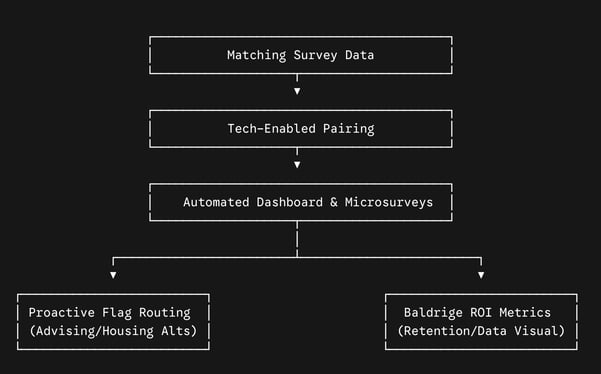
By utilizing Mentor Collective’s tech-driven architecture, UW-Stout systematically streamlined three major operational bottlenecks:
- Frictionless Matching: Advanced matching algorithms paired students based on highly granular, participant-centered data (such as aligning construction management majors with senior peers in the same discipline), yielding exceptional compatibility rates.
- Automated Early Alerts: Tech-driven micro-surveys surface real-time barriers. When a mentor logs a "priority flag" signaling a student issue, the system automatically routes the alert to Wenig, who can instantly mobilize campus resources.
- Executive Visibility: The analytics dashboard equips leadership with the clear data visualizations and KPIs required to map student outcomes directly to institutional ROI. In fact, UW-Stout is utilizing these mentorship data insights in its upcoming Malcolm Baldrige National Quality Award application.
4. Looking Ahead: Mentorship as a Communication Engine
As institutions face shifting academic structures, a scaled mentorship program becomes more than a retention tool—it serves as a dynamic, trusted communication channel.
Currently, UW-Stout is navigating a major structural shift by consolidating two disparate campus advising strategies back into a singular, unified professional model. Rather than relying solely on traditional top-down email campaigns to announce the change, Wenig is leveraging his scaled peer network to demystify the transition.
"I have a direct line to every incoming student who needs to hear about major changes on campus," said Wenig. "If you create a strong culture of mentorship and have student leaders who buy into your mission, that energy radiates outward. They become your greatest ambassadors."
The Bottom Line
Student retention isn't driven by a single isolated initiative; it's driven by how deeply a student feels they belong at their chosen institution. By marrying intentional student leadership with automated, scalable technology, UW-Stout has proven that large-scale campuses can deliver deeply personal, equity-minded support networks that move the needle on institutional persistence.
Watch the Recording
Is your campus ready to scale human connection?
Discover how Mentor Collective’s tech-enabled infrastructure can help your institution move past the constraints of manual spreadsheets to build a sustainable, data-informed culture of peer mentorship.
Schedule a strategic consultation today.