For VPs, deans, and higher education leaders facing mounting pressure around student persistence and equitable outcomes, implementing a peer mentorship program often feels like a balancing act between resource constraints and impact. While most leaders intuitively recognize mentorship as a high-impact practice, few institutions can reliably isolate its return on investment—let alone scale it across an entire college without exhausting staff capacity.
At Montclair State University’s College of Humanities and Social Sciences (CHSS), this tension was met with a long-term strategic vision. Starting eight years ago as a targeted pilot aimed at closing retention gaps, CHSS’s peer mentorship program has evolved into an institutional cornerstone.
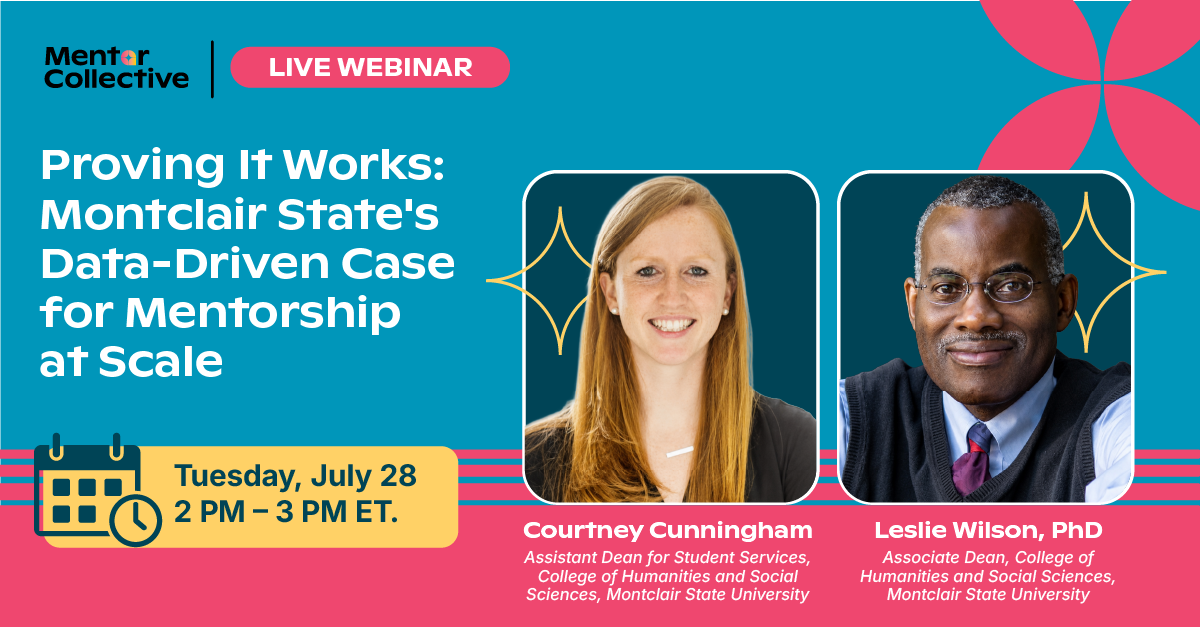
During a recent Mentor Collective webinar, Proving What Works, Dr. Leslie Wilson (Associate Dean) and Courtney Cunningham (Assistant Dean) shared how CHSS built an evergreen data infrastructure, drove a 10% retention lead among high-need cohorts, and prepared to expand mentorship to 100% of their incoming first-year class—all while requiring just a fraction of the administrative lift it took at launch.
1. Proving the ROI: Moving from Excel Fixations to Dynamic IR Dashboards
When the CHSS dean’s office first launched the mentorship initiative, the goal was urgent: first-year and third-year retention rates within the college were lagging behind the broader university baseline. To justify sustaining and expanding the program, leadership needed concrete proof that peer connection was moving the needle.
Instead of relying on static Excel spreadsheets that freeze data in time, the CHSS team partnered directly with Montclair State’s Institutional Research (IR) team. By exporting participant tracking data directly from the Mentor Collective dashboard and blending it with institutional SIS records, they built a dynamic, reusable executive dashboard.
The result? CHSS demonstrated that mentored first-year students achieved a 4% to 7% boost in year-one retention compared to non-mentored peers.
"The dashboard made it easy to filter by participants versus non-participants and dig into specific cohorts—first-gen, commuters, high school GPA, race, and ethnicity. Once we had that system set up with IR, it became evergreen. We can plug in numbers year after year and continuously prove impact to new leadership."
— Courtney Cunningham, Assistant Dean, CHSS

2. Closing the Equity Gap: Intentionality Meets Relatability
While broad retention lifts validate executive buy-in, the true test of student support lies in equity. CHSS leveraged their data to analyze how peer mentorship impacted historically underserved populations, discovering that Pell-eligible and first-generation mentored students retained at rates up to 10% higher fall-to-fall than their non-mentored counterparts. This success wasn’t accidental; it was driven by two key strategies:
- Captive Audience Onboarding: Rather than burying mentorship sign-ups in generic summer mailings, CHSS integrated a 10-minute presentation directly into the mandatory academic session at student orientation. Putting a live QR code on screen while explaining the tangible benefits yielded over 500 opt-ins out of ~800 incoming freshmen.
- Reflective Mentor Pools: CHSS intentionally recruited upperclassmen who shared similar lived experiences. First-generation incoming students matched with first-generation upperclassmen or graduate mentors immediately gained a psychological safety net—someone to ask about parking, textbooks, or navigating campus life without the intimidation of visiting an administrative office.
3. Scaling Infrastructure Without Blowing Out Staffing Budgets
A major hesitation for provosts and deans evaluating large-scale student support is headcount cost. Building, matching, training, and tracking a 500+ student network internally usually requires dedicated, full-time program managers.
When evaluating the cost-benefit of manual administration versus tech-enabled infrastructure, Cunningham noted that attempting to build and manage the workflow in-house would require a full-time position with salary, fringe, and benefits—exceeding the annual cost of an external operating system. More importantly, automated technology freed up leadership time:
- 1/10th the Administrative Lift: When the program launched eight years ago, Cunningham was the college’s sole advisor and Wilson was assistant to the dean. Today, as Assistant and Associate Deans with significantly expanded portfolios, they spend standardly 1/10th of the time managing the program compared to year one.
- Automated Early Warnings: The platform’s micro-surveys and automated prompts log thousands of touchpoints annually, surfacing friction early. Over the past year, 68 high-priority flags were automatically routed to financial aid and academic support offices for rapid intervention before students dropped out.
- Proactive Student Prompts: Automated SMS prompts remind mentors to check in and log interactions, capturing qualitative context (e.g., academic stress, sense of belonging) without requiring manual follow-up from administrators.
4. Operationalizing "Mentorship for All": Expanding from 500 to 850 Students
As CHSS prepares for the upcoming academic year, they are taking the ultimate leap: moving from an opt-in model to a "Mentorship for All" framework, automatically matching all 850 incoming first-year students with a peer mentor on day one.
For institutions hesitant to make the jump from a targeted pilot to full institutional scale out of fear that disengaged students will dilute program metrics, Wilson offers a straightforward financial and operational rationale:
"For most leaders, cost is the top priority. If you can help 100 students, but you can also help 850 students using the same infrastructure, why wouldn't you help all 850? By matching everyone on day one, we eliminate friction for students who need support the most but might be hesitant to opt in. We have nothing to lose and everything to gain."
— Dr. Leslie Wilson, Associate Dean, CHSS

The Bottom Line
Building student persistence isn't about launching isolated, transactional initiatives; it's about embedding a sustainable culture of belonging into the institutional lifecycle. By pairing low-stakes, flexible student connections with tech-enabled infrastructure and robust IR integration, Montclair State CHSS has proven that colleges can deliver personal, high-touch support at full scale—driving measurable retention gains that stand the test of leadership transitions and changing demographics.
Watch the Recording
Is your campus ready to scale human connection?
Discover how Mentor Collective’s tech-enabled infrastructure can help your institution move past the constraints of manual spreadsheets to build a sustainable, data-informed culture of peer mentorship.
Schedule a strategic consultation today.