
The Massachusetts SUCCESS (Supporting Urgent Community College Equity through Student Services) Fund has provided a vital blueprint for closing equity gaps. By shifting from traditional "available" services to "proactive" peer-led ecosystems, Middlesex Community College and Greenfield Community College have turned a state-funded initiative into measurable persistence.
A central challenge identified by these institutions is the Engagement Gap: the reality that 72% of students do not utilize traditional, office-based support services, even though they are 9 times more likely to disclose critical challenges to a peer (Johnson et al, 2022).
This post highlights the key strategies shared during our recent webinar, "Massachusetts SUCCESS Fund in Action: Mentorship Models that Drive Student Outcomes," which explored how state-funded programs are transforming the student experience.
Here is how these two institutions are leading the way:
Middlesex Community College: Overcoming the Administrative Plateau
Middlesex Community College recognized early on that a successful peer mentorship program for their "Success Scholars" required moving away from manual management.
- The Challenge: Leadership found they were at their limit with manual matching and administrative work, which prevented staff from focusing on high-level student support.
- The Strategy: By shifting the logistics of their program, they ensured that success coaches remained available for direct student intervention rather than being buried in spreadsheets.
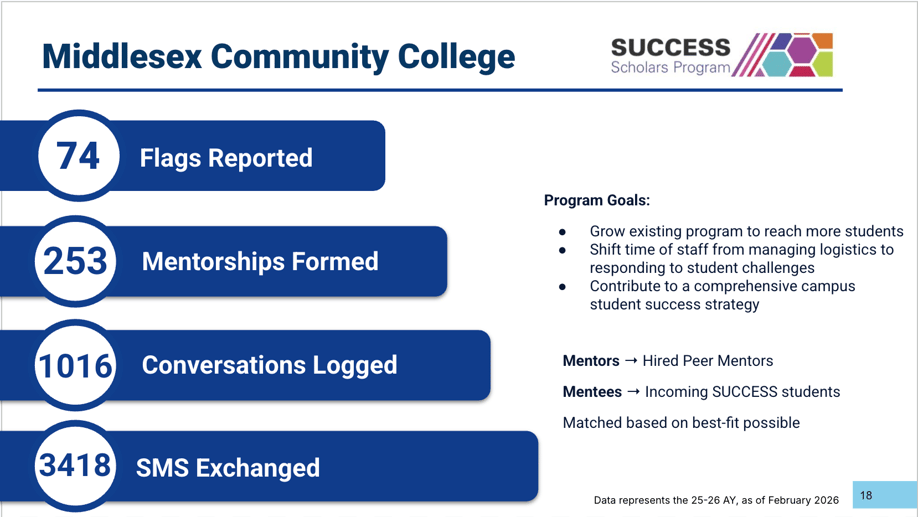
- The Impact: Middlesex scaled to 253 mentorships and over 1,000 conversations in a single year. This volume allowed them to identify 74 proactive "flags"—early warning signs like financial stress or housing instability—enabling staff to intervene weeks earlier than traditional outreach methods.
The whole goal was to keep our success coaches available at peak times to meet with students as opposed to doing all of this administrative work. — Tiffany Laudano
Greenfield Community College: Lowering the Threshold for Support
To ensure that every student has an equal start, Greenfield Community College fundamentally changed how students access support through an inclusive matching strategy.
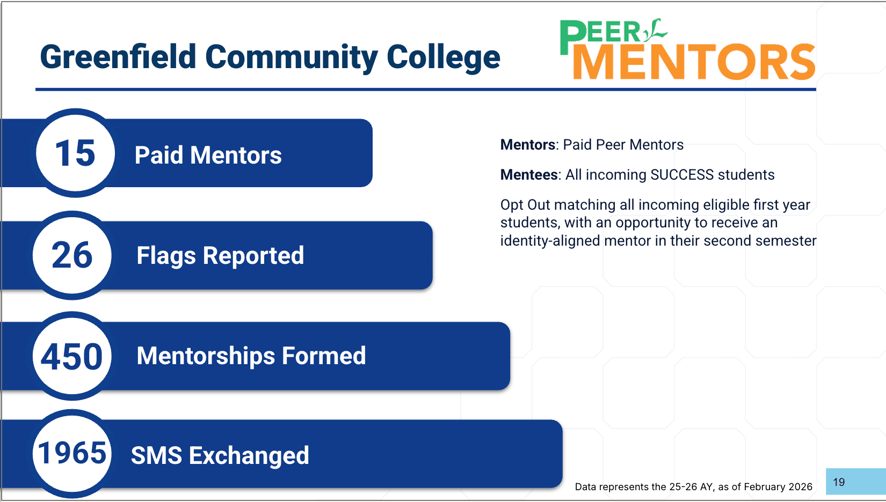
- The Strategy: They moved away from elective sign-ups, automatically pairing every eligible incoming first-year student with a peer mentor from day one.
- The Impact: This approach normalized support as a standard part of the first-year experience, resulting in 450 active mentorships and nearly 2,000 SMS messages exchanged.
- Removing Barriers: This model ensures that students don't have to navigate complex "help-seeking" behaviors. Instead, mentors proactively direct students to campus resources—like the library or advising—before a minor hurdle escalates into a crisis.
"I think the sort of casual contact of somebody who's just looking out for them, especially in their first semester, has been really valuable." — Holly Kosisky
Data-Driven Results: The "Rule of Three"
Both institutions have seen their SUCCESS Fund efforts validated by a key benchmark: the "Rule of Three".
-
Persistence Correlation: When a mentorship pair engages in three or more meaningful conversations, there is an average +11% increase in student retention.
-
Real-Time Intervention: Because peer mentors use casual check-ins via SMS, they often hear about a student’s desire to drop out or change their major long before it reaches a formal office.
Building a Sustainable Persistence Ecosystem
The success at Middlesex and Greenfield demonstrates that the Massachusetts SUCCESS Fund is most effective when used to build a sustainable, proactive ecosystem. By leveraging peer-led strategies, these institutions have ensured that every grant dollar translates into a meaningful connection, keeping more students on track for graduation. Watch the full webinar below!
Want to see how we're turning these insights into reality?
Schedule a Consultation →