For higher education leaders facing growing enrollment pressures, rising student attrition, and state-level funding tied to completion rates, the community college transfer pipeline remains one of the most critical—yet leakiest—pathways in higher education. While national data shows that over 80% of community college students enter higher education intending to earn a bachelor’s degree, fewer than 35% successfully transition to a four-year institution, and only 16% earn a bachelor’s degree within six years.
Closing this gap requires more than credit evaluation checklists, articulation agreements, or automated email campaigns. It demands a scalable, human-centered bridge that builds belonging long before a student ever sets foot on a university campus.
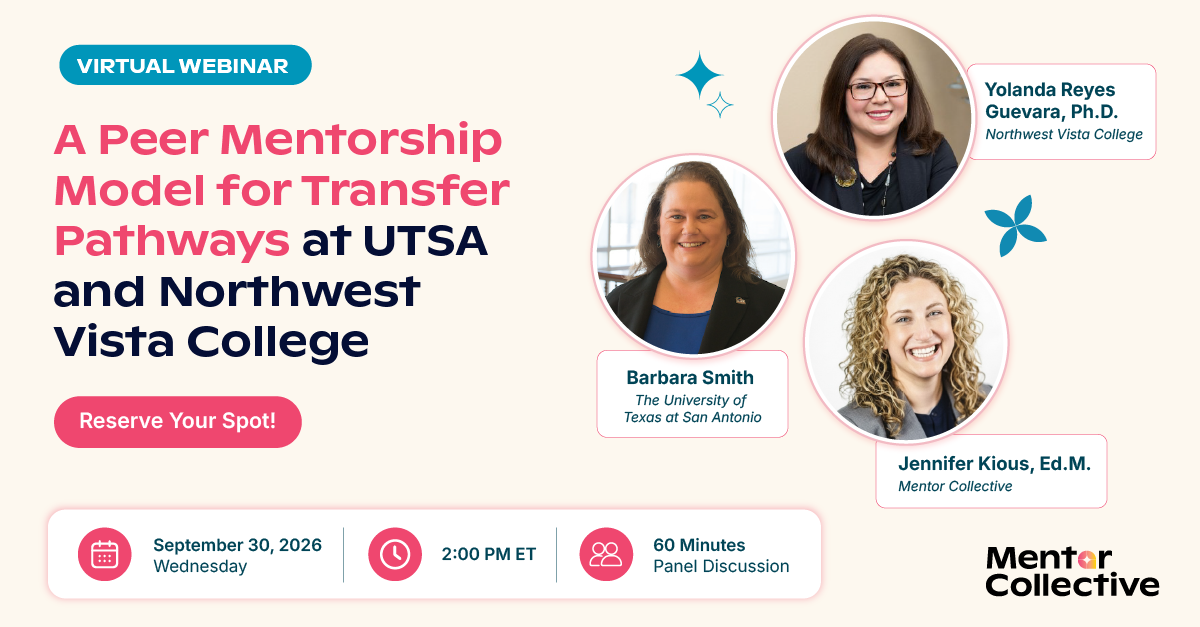
During a recent Mentor Collective webinar, higher education leaders Yolanda Reyes Guevara (Director of Academic Programs at Northwest Vista College) and Barbara Smith (Executive Director of Transfer and Transition Student Success Services at The University of Texas at San Antonio) shared how their institutions partnered to replace a fragmented hand-off with a unified, cross-institutional peer mentorship model.
By leveraging tech-enabled peer connection, UTSA and Northwest Vista College (NVC) bridged the institutional divide, surfaced real-time non-cognitive student flags, and saved nearly 1,400 hours in administrative capacity—all while scaling high-touch support across thousands of transfer students.
1. Beyond the Credit Checklist: Eliminating the Non-Cognitive Transfer Barrier
Traditional transfer orientation and degree-audit tools ensure academic eligibility, but they rarely address the psychological friction that derails transfer students: imposter syndrome, intimidation, and navigating hidden campus culture.
When community college students consider stepping onto a university campus with over 30,000 students, the primary hurdles are often social rather than academic. Administrators are uniquely unequipped to answer the low-stakes, high-friction questions that dictate a student's daily confidence.
"There are just questions students aren't going to ask us as administrators," explains Yolanda Reyes Guevara. "A student might be intimidated asking a director or executive director where to go for lunch, what parking looks like, or how to navigate campus life. Having a peer mentor creates that comfort level so they don't feel lost in such a large university."

By pairing prospective transfer students with upperclassmen who successfully navigated the exact same pathway, the partnership demystifies the university experience long before application deadlines arrive.
2. Structural Partnership: Shifting from Institutional Silos to "Our Students"
Building an effective cross-institutional pipeline requires moving past transactional hand-offs toward shared institutional ownership.
Northwest Vista College—the largest feeder institution to UTSA within the Alamo Colleges District—and UTSA aligned their strategic goals under a unified philosophy: students aren't "yours" or "ours"; they belong to the collective pipeline.
Rather than waiting for formal admission, NVC invites students to opt into the transfer mentorship program as early as 15 credit hours into their associate degree journey. During a recent recruitment cycle, NVC opened the opportunity to 1,500 students who expressed intent to transfer, instantly surrounding them with university-level peer support.
"We didn't look at it as a student just belonging to Northwest Vista or just UTSA," says Barbara Smith. "We looked at students across both campuses and said, 'They are our students.' If they're at Northwest Vista and intend to come to UTSA, we need support in place right now."

3. Early Warning Indicators: Catching Friction Before Midterms
Waiting for midterm grade reports to identify struggling transfer students is often too late. Through Mentor Collective’s automated flag infrastructure, mentors capture non-cognitive indicators—such as acute personal stress, financial hardship, or food insecurity—and immediately escalate them to professional staff.
Instead of requiring students to independently seek out campus support, automated flags trigger proactive outreach from UTSA’s Transfer and Transition Student Success Services team.
Primary Friction Points Surfaced Early via Mentorship Flags:
- Basic Needs & Financial Constraints: Identifying couch-surfing, housing insecurity, and delays in textbook purchasing before coursework falls behind.
- Academic & Exam Anxiety: Directing students toward tutoring resources and UTSA's 24/7 counseling applications ahead of high-stress midterm periods.
- Campus Integration: Connecting incoming transfer students directly to "Roadrunner Days" events, specialized transfer welcome groups, and academic peer networks.
4. Scaling High-Touch Support Without Staff Exhaustion
For provosts, deans, and vice presidents, expanding high-touch student support across multiple campuses often raises immediate concerns regarding headcount and operational cost. Building, matching, nudging, and tracking a multi-institutional network manually via spreadsheets is administrative suicide.
By offloading the manual lift of mentor recruitment, algorithmic matching, and automated communication workflows to Mentor Collective, UTSA expanded its transfer support network while achieving dramatic operational returns:
- Approximately 1,400 Administrative Hours Saved: Equal to $31,000 in direct administrative value, by eliminating manual spreadsheet management, outreach nudges, and intake coordination.
- Volunteer-Driven Mentorship: UTSA’s peer mentors participate on a volunteer and recognition basis, eliminating direct stipend overhead while fostering an authentic culture of giving back.
- Real-Time Data Integration: Executive leadership gains continuous visibility into student engagement trends, sentiment, and population-level needs without manual survey consolidation.
Strategic Guidance for Higher Education Executives
For leaders evaluating their transfer ecosystems, Reyes Guevara and Smith highlight two foundational imperatives:
- Leverage Institutional Data for Buy-In: Audit your internal transfer metrics. If 80% of your community college population intends to earn a four-year degree but institutional completion drops below 20%, the data itself creates the strategic mandate for cross-institutional alignment.
- Expand the Horizon of Student Success: Community college commitment cannot end at associate degree completion; four-year university commitment cannot begin on Day 1 of fall classes. Sustainable student success requires surrounding students along the entire continuum toward high-wage, family-sustaining careers.
Watch the Recording
Is your campus ready to bridge the gap?
Schedule a demo to learn more today